World Immunization Week is celebrated in the last week of April, at the initiative of the WHO, in all countries of the world. The goal of this large-scale event is to increase public understanding of the importance of vaccination for preventing dangerous diseases and saving lives.
5 important facts about immunization
- Immunization saves 2 to 3 million lives each year.
- Thanks to immunization, there are no more cases of smallpox in the world – this dangerous disease, which killed 3 out of 10 people, has been completely eradicated.
- Now, thanks to mass vaccination campaigns, the world is closer to eradicating polio, a dangerous disease that can lead to incurable paralysis. As recently as 1988, the virus was circulating in 125 countries around the world, with 350,000 cases. Now, there are only two countries where the «wild» polio virus is still circulating – Afghanistan and Pakistan; as of February 29, 2024, only 15 cases of the disease had been recorded in these countries. It is also important to note that polio types 2 and 3 have already been eradicated, and only polio type 1 is currently recorded in the world.
- Maternal and neonatal tetanus was eliminated in Southeast Asia in 2016. This region is home to about a quarter of the world’s population and is the second of six WHO regions to achieve elimination of maternal and neonatal tetanus. In 2017, the Americas became the third WHO region to eliminate this deadly disease among mothers and infants. Unfortunately, tetanus cannot be completely eliminated because the bacteria that cause it are found in the environment – in the soil and feces of many animals. However, this dangerous disease can be prevented by adhering to hygiene requirements during childbirth and vaccination, the effectiveness of which, with timely revaccination, reaches 100%.
- Some vaccines prevent cancer, namely the hepatitis B vaccine, which prevents the development of liver cancer caused by complications of hepatitis B, and the human papillomavirus vaccine, which prevents the development of 6 types of cancer caused by the human papillomavirus.
What vaccinations are mandatory?
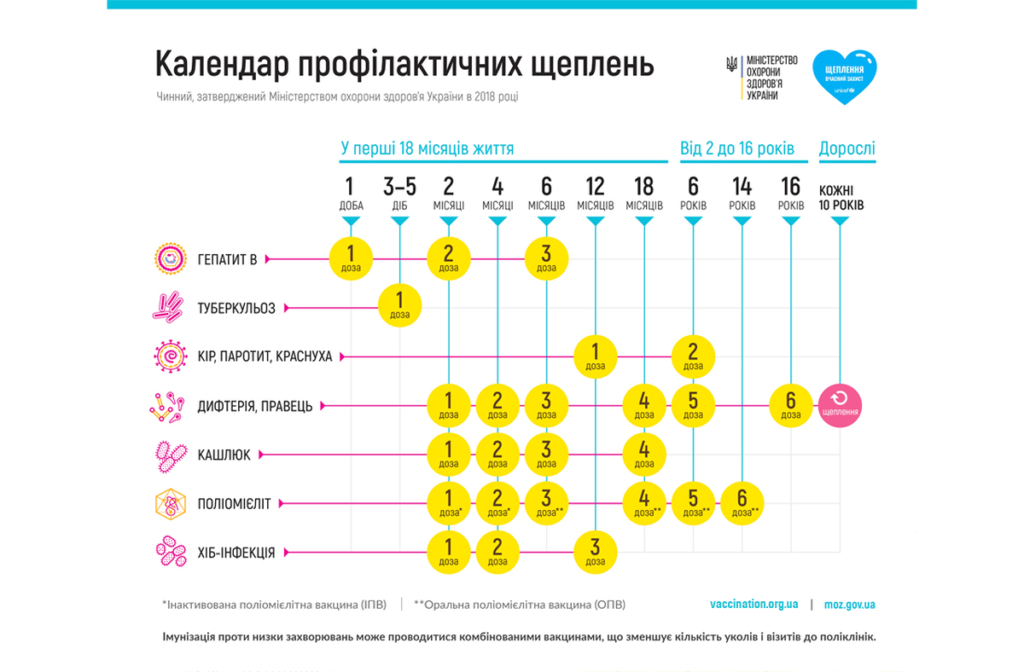
For the best protection against diseases, a child should be vaccinated on time, starting at 1-2 months of age, and follow the recommended schedule as closely as possible (with a vaccination calendar up to a year).
What vaccinations are given to children under one year old?
Hepatitis B vaccination.
Hepatitis B is an acute viral liver disease that is difficult to treat and often becomes chronic. A child can catch hepatitis from the mother during childbirth, as well as during a blood transfusion, a visit to the dentist, surgery, etc. Vaccination is done within 12 hours after birth, and then at 1 and 6 months of life.
BCG vaccination.
It is necessary to vaccinate a child against tuberculosis in the maternity hospital, on the 3-5th day after birth, because if this is not done, the primary infection with mycobacteria threatens the disease. Actually, BCG provides anti-tuberculosis immunity, which protects the child's body from the disease during the primary and subsequent contacts with mycobacterium tuberculosis, and also prevents the development of generalized forms of tuberculosis, if the disease still develops later.
Already in the second month, the child is vaccinated against 5 infections: DTP vaccination (against diphtheria, pertussis, tetanus), polio, and hemophilic infection.
PDA vaccination.
At one year of age, a child is recommended to receive the MMR vaccine: measles, rubella, and mumps (mumps) vaccine. Measles is an acute infectious disease that is not at all harmless. Yes, this disease is still one of the leading causes of death among young children worldwide. Rubella and mumps are no less dangerous. Mumps, for example, often cause serious hearing impairment, nervous system dysfunction, reproductive function, etc.
Diphtheria vaccination.
Diphtheria is an infectious disease of the oropharynx caused by the Loeffler bacillus, transmitted by airborne droplets. Complications of diphtheria include myocarditis (infection of the heart muscle), paralysis of the soft palate, neck muscles, vocal cords, respiratory tract, and extremities.
Tetanus vaccination.
Tetanus is caused by anaerobic bacteria – clostridia, which when entering the body through wounds (cuts, punctures, burns, bites) act on the nervous system, causing severe convulsions. Asphyxia, paralysis of the heart and breathing can occur as a result of convulsions. Mortality from tetanus even today reaches 25-80%.
Vaccination against Whooping Cough.
Whooping cough is the most dangerous infection for children under 2 years old. This disease is caused by Bordet-Jean bacteria, which are transmitted through the air. The disease manifests itself as a «barking», spasmodic cough, which is very often complicated by pneumonia, convulsions and encephalopathy. What is noteworthy, the innate immunity, due to maternal antibodies, does not develop in the child!
Vaccination against Polio.
Just 65 years ago, polio was a real sentence for children, causing spinal paralysis. Only thanks to the efforts of WHO and other organizations has the disease been almost eradicated through vaccination (the number of cases has decreased by more than 991%.
Vaccination against Hib infection.
Haemophilus influenzae is a group of acute conditions caused by Haemophilus influenzae. Children under 2 years of age are particularly susceptible to the pathogen. Transmitted by airborne droplets, Haemophilus influenzae causes purulent meningitis, pneumonia, sepsis, inflammation of the subcutaneous tissue and other dangerous pathologies.
Vaccination is necessary to protect your child!
By refusing vaccination, you are risking the health and life of your child!