
Introduction
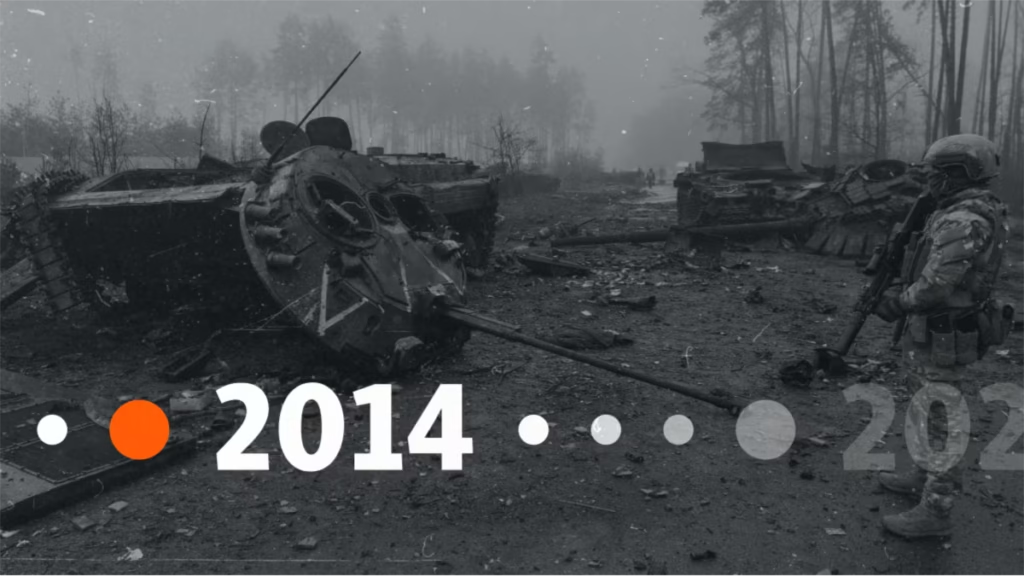
In February 2014, the modern Russian-Ukrainian war began. Then, 11 years ago, the Russian Federation occupied the Autonomous Republic of Crimea and Sevastopol, as well as certain areas of Donetsk, Luhansk, and Kherson regions. Until February 24, 2022, the main events of the war, with varying intensity of hostilities, took place in the east of our country. Although the confrontation with Russian hybrid aggression took place not only on the front line, but also throughout the territory of Ukraine.
Russia unleashed an imperialist - aggressive - and existential war against Ukraine, aimed not only at seizing territory, but also at destroying Ukrainian statehood, our national identity, and committing genocide against the Ukrainian people. The full-scale invasion on February 24, 2022 was a new stage in the war that began in 2014. The resistance to aggression after February 24, 2022 consolidated Ukrainians.
Key messages
Since 2014, Ukraine has been waging a just war to preserve its independence, for the right to a free European and Euro-Atlantic choice, for sovereignty and territorial integrity. Until February 24, 2022, the main military actions did not go beyond the east of our country. For eight years, the Armed Forces of Ukraine, together with volunteer formations and volunteers, effectively restrained the armed aggression of the Russian Federation, liberating most of the territories it had captured at that time. On February 24, 2022, Russia launched an open full-scale war against Ukraine.
This war has brought a threat to the peace and security of the European continent, has led to a violation of stability and balance in the global dimension. And for us, the war has an existential nature – it is for survival. Because the Russian invader in the temporarily occupied territories is fully implementing the genocide of the Ukrainian people – destroying our culture, literature, mobilizing the Ukrainian population, throwing them into battle against their own.
The war in and for Ukraine did not start suddenly. The full-scale attack is another attempt to break Ukraine, to turn a sovereign state into a simulacrum, and its people into a «population» similar to the Russian one. The open war against Ukraine was planned long ago, and in latent and hybrid forms it lasted all the years of our independence.
The war did not spare any family, it touched everyone. And everyone goes through this ordeal differently. But what is common to many is the desire for victory, the desire to destroy the enemy, to stand firm and maintain independence. This motivates action and mobilizes efforts.
The war has hardened and united us. Today we are united by the memory of the dead, common pain and common responsibility, the desire to avenge all those killed and tortured by the racists. To survive, we have only one way out - victory.
In the most difficult times of our history, Ukrainians united to repel the enemy, en masse rose to defend their native land. Our readiness to resist is a decisive guarantee of victory.
This was understood by those tens and hundreds of thousands of Ukrainians who voluntarily joined the ranks of the defenders of Ukraine. They, leaving their businesses or successful careers, put on military uniforms.
Thousands of Ukrainians are volunteering. They have given everyone else a chance to prepare and find their place in this war. But we will be able to win only through the joint efforts of all Ukrainians. We have this chance and we have no right to lose it.
National unity ensured successful resistance to the Russian aggressor. The Ukrainian people demonstrated to the world examples of courage, resilience, courage, resourcefulness, and unity in the face of a cruel, numerically superior enemy.
The heroic resistance of Ukrainians is not only a struggle for the physical survival of the Ukrainian people and the freedom of the country. In this war, Ukraine defends its right to exist, national identity, European choice and values. Ukrainians shed blood for a free, democratic Europe. And today, as a result of the military aggression of the Russian Federation, unfortunately, Ukraine has not only the Heavenly Hundred, but also an entire Heavenly Army.
But Ukrainians persevered and proved their ability to defeat Russian military aggression. Today, Ukraine is holding it back thanks to efforts on the military and information fronts, as well as international assistance. But above all, we are grateful to our courageous and steadfast defenders from the Security and Defense Forces.
It is worth realizing that the threat level remains high. Today, the enemy has no intention of stopping, does not count on losses. Therefore, we have no right to allow the aggressor to undermine our unity, readiness and ability to resist. We must maintain the spirit of freedom and solidarity.
Pages of invincibility
From February 20 to March 14, we celebrate a series of dates designed to remind us of our society's resistance to arbitrary power and enslavement:
On February 20, Ukraine will commemorate the Heroes of the Heavenly Hundred under the slogan of the celebration - "Heroes of the First Victory in the Ongoing Battle.".
February 24 is the day of the Russian Federation's full-scale invasion of Ukraine.
On February 26 – the Day of Resistance to the Occupation of Crimea – we honor the courage of thousands of Crimeans who on this day in 2014 took to the streets in Simferopol to support the territorial integrity of Ukraine.
March 14 – Ukrainian Volunteer Day.
Through our modern resistance to Russian aggression, we have proven our unity, our common desire to determine the future, and our readiness to fight for it. Now we must maintain the ability to rise up en masse to defend our homeland, and it is also important to organize ourselves to cooperate in rebuilding Ukraine after victory.
February 20. Day of the Heroes of the Heavenly Hundred and the beginning of the Russian-Ukrainian War
The Orange Revolution and the Revolution of Dignity showed that Ukrainian society valued democracy and freedom and saw itself as part of Europe. This contradicted Russia's plans to increasingly exert influence over Ukraine and draw it into its own geopolitical projects.
Under the slogan "We cannot be defeated!", millions of Ukrainians took to the streets in 2004 and 2013–2014 to peacefully protest against Russia's aggressive hybrid policy aimed at returning Ukraine to its full influence and control.
With the coming to power of Viktor Yanukovych in 2010, Ukrainians repeatedly rallied in rallies – Tax (2010), Language (2012), Vradiyivskyi (2013) Maidans. Then Ukrainians revolted against the arbitrariness of the authorities, the impunity of officials, and the suppression of democratic rights and freedoms of people.
The culmination of the protests was the Revolution of Dignity. It began on November 21 because the government refused to sign the Association Agreement with the European Union. This decision by the corrupt clan of then-President Viktor Yanukovych not only dashed hopes for systemic reforms and a pro-European course of development for the state, but could also deepen Ukraine's dependence on Russia to the point of losing its statehood. The action grew into a struggle of unwavering Ukrainians, ready even with wooden shields to go to the equipment and under bullets, in defense of rights and dignity. Thanks to this steadfastness, unity and self-organization, Ukrainians persevered, overthrew the regime of Viktor Yanukovych and returned Ukraine to the European path of development.
After the victory of the Revolution of Dignity on February 20, 2014, Russia launched armed aggression against Ukraine and occupied Crimea.
In March 2014, Russia began to destabilize the situation in the southern regions. Led by Russian special services, participants in the “anti-Maidan” in Donetsk, Dnipro, Odessa, Kherson, Zaporizhia, and Kharkiv gathered rallies and called for the seizure of regional state administrations. At the same time, mass actions in defense of the sovereignty and integrity of Ukraine swept through many cities - Sumy, Dnipro, Zaporizhia, Poltava, and Mykolaiv.
In early April, enemy special services began implementing the «Novorossiya» plan and initiated another wave of destabilization. Patriotic Ukrainians desperately resisted the offensive of the «Russian Spring.» And it was finally thwarted by the people of Odessa on May 2, 2014.
According to the Security Service of Ukraine, pro-Russian actions in Odessa in the winter-spring of 2014 were inspired by Russia - local separatist leaders received direct instructions from supervisors in Moscow to destabilize the situation. Thus, on March 9, in response to the decision of the Odessa Regional Council, pro-Russian forces set up a tent camp on Kulikovo Field, where they held rallies calling on the Russian Federation to send troops into Ukraine. Russian citizens were among the organizers of the actions.
On May 2, 2014, a football match was to be held in Odessa between Odessa's Chornomorets and Kharkiv's Metalist. Patriotic activists planned to hold another Peace March before the game, this time with the Chornomorets fan club. Pro-Russian protesters announced the mobilization of supporters. So, when the column of Peace March participants set off from Cathedral Square, people from Kulikovo Field blocked their way. Clashes broke out on Gretska Street. Six Odessans, including the centurion of the Right Sector, lawyer Igor Ivanov, were shot dead by pro-Russian militants right in the city center.
Local businessmen, restaurateurs, and passersby who found themselves in the epicenter of the events supported the participants of the Peace March. To stop the armed militants, they began to erect barricades from tables and chairs of street cafes and garbage cans. Cobblestones became "bullets", and gasoline from parked cars was used for "Molotov cocktails.".
Despite the fact that the attackers had traumatic and firearms, as well as the loyal attitude of the police, after several hours of intense street confrontation, their strength was exhausted, they began to flee and barricade themselves in the House of Trade Unions near Kulikovo Field. From the roof and windows of the building, they opened «fire» at Ukrainian activists with «Molotov cocktails» and stones. Molotov cocktails and paving stones also flew into the premises where the pro-Russian forces were camped.
Soon a fire broke out on the stairs of the Trade Union Building. The circumstances of its occurrence have not yet been clarified. The synthetic material under the stairs began to smolder. Toxic smoke filled the entire building, and the temperature exceeded all critical indicators. Many people died from carbon monoxide poisoning and from falls from a height. In total, 48 people from both sides became victims of the confrontation, and more than 200 people were injured.
February 24. Full-scale invasion
On this day in 2022, the Russians began an open, armed, full-scale invasion of Ukraine - Vladimir Putin announced the start of the so-called SVO - a special military operation aimed at the "demilitarization" and "denazification" of Ukraine. Within minutes, Russian missiles from the territory of Belarus and temporarily occupied Crimea attacked Ukrainian airfields and military facilities throughout Ukraine. The Russian-Ukrainian war, launched by the Russian Federation in 2014, entered a new acute phase.
The Russians were counting on a lightning-fast takeover of Ukraine, as they were convinced that Ukrainians were waiting for the Russians with bread and salt. But in fact, from the first hours of the invasion, the aggressor's army met fierce resistance not only from the fighters of the Armed Forces of Ukraine and the National Guard, but also from ordinary citizens united in territorial defense units, volunteer formations of territorial communities, and volunteer organizations.
In the first months of the war, the world was amazed by the facts when residents of cities in Kharkiv or Chernihiv regions took to the streets and squares, stopping Russian military equipment without weapons. When protests under Ukrainian flags did not stop for more than a month in occupied Kherson, Energodar, and Melitopol. When people from Kyiv or Odessa collected bottles and filled them with Molotov cocktails. When people captured occupiers, armored vehicles, and weapons with their bare hands and handed them over to the Armed Forces of Ukraine. There are many such examples of struggle and heroism of Ukrainian civilians.
In all cities, lines of experienced soldiers, reservists, and ordinary men and women, often quite young, who wanted to defend their homeland, formed in front of military registration and enlistment offices.
«"As they say, there was nowhere for the apple to fall. As a joke, I can add that it was a commissar's dream to get a call asking you to help enlist. They called me and my colleagues. People told me about the queues and asked to help give them the opportunity to defend the country. There were many women in the queues. People of respectable age came. This was not only in February, but also in March, when the enemy was near Kyiv. Medical students also came with medicines, offering to provide medical assistance in the event of street fighting. A young man who looked about 17 years old also came. He told us: 'I know that you will not take me into the army, but I did not come empty-handed.' He brought 'cocktails for Putin', about 10 bottles," recalled Colonel Yuriy Maksimiv, head of the Kyiv City Recruitment and Social Support Center, in an interview with TSN.
February 26. Resistance to the occupation in Crimea
On February 26 – the Day of Resistance to the Occupation of Crimea – we honor the courage of thousands of Crimeans who on this day in 2014 took to the streets in Simferopol to support the territorial integrity of Ukraine.
It was the time of the unfolding of Russia's war against Ukraine, which began precisely in Crimea. On February 24, 2014, the ships of the Russian Navy, which had finished guarding the waters around the Winter Olympics (Sochi), took on board the "little green men" (Russian military personnel without identification marks) along with military equipment in Novorossiysk and headed for Sevastopol.
The next day, about 400 pro-Russian people picketed the building of the Supreme Council of the Autonomous Republic of Crimea in Simferopol, demanding the removal of Ukrainian state symbols and a referendum «for Crimean independence.» To prevent this from happening, the Mejlis of the Crimean Tatar People called on Crimean Tatars, Ukrainians, and representatives of other nationalities to gather for a peaceful protest in opposition to the Russian occupation and support for the integrity of Ukraine.
On February 26, a pro-Ukrainian rally was held near the Crimean parliament, which was attended by between 5,000 and 10,000 participants and which prevented an extraordinary session of the parliament and a review of the status of the autonomous republic within Ukraine. That day, the rally participants had to come together in confrontation with the illegal formation «People’s Militia of Crimea» and «Cossack» organizations, which were specially mobilized by pro-Russian forces. Two Ukrainian citizens died after injuries, allegedly received in a stampede on the square. 30 people sought medical help.
However, the next day at 5 am, regular Russian military units entered the parliament and government of Crimea and seized the buildings. On February 28, the Supreme Rada of Crimea, under the "supervision" of Russian military personnel, voted for a referendum. Russian units began to block Ukrainian military units and facilities on the peninsula, seized the Belbek and Simferopol airports, and land entrances to Crimea from the Kherson region.
A pseudo-referendum on the status of Crimea was held on March 16, 2014. The Russian-orchestrated «election» was boycotted by Crimean Tatars and other pro-Ukrainian residents of the peninsula. On March 25, the Russians seized the Ukrainian Navy minesweeper Cherkasy, the last force flying the Ukrainian flag in Crimea.
Since then, the peninsula has been temporarily occupied by Russia, where political persecution of civil society activists continues.
March. Defense of Kyiv, Chernihiv, Kherson, Sumy and Mykolaiv regions
At the beginning of the invasion of Ukraine in 2022, the Russian Federation threw all its forces into a lightning-fast capture of Kyiv. The Russian ground forces were to quickly advance through regional centers from the south, north-east and east and approach the capital. The occupier planned to take it in no more than 3–5 days.
Fierce fighting began in the Kyiv region on the first day of the full-scale invasion. The aggressor tried to land troops at the Gostomel airfield and capture Kyiv with the support of heavy armored vehicles and artillery that entered through the Chernobyl zone. This column of Russian equipment reached Bucha in 3 days, but did not advance further. The stubborn resistance of the Armed Forces of Ukraine and territorial defense thwarted the intentions of the Russian Federation. Due to the futility of attempts to break through to Kyiv, at the end of March the Russian command decided to withdraw troops from the Kyiv region.
In the Chernihiv region, the main logistical artery was to be the Novi Yarylovychi - Chernihiv highway, from where the means of warfare would be transported by rail and highway across the Desna River. The resistance of Ukrainians in the Chernihiv region - both military and local residents - thwarted all the enemy's plans.
The first to be hit by the Russians in the Chernihiv region was the village of Dniprovske on the border with Belarus, as well as the border posts "Novi Yarylovychi", "Gremyach", "Senkivka", the airfield in Nizhyn, the training building of the 1st separate tank Siverskyi brigade in Honcharivske. The enemy group "Center" entered from the side of Belarus through Dobryanka, Gorodnya in the direction of Ripok, Mykhailo-Kotsiubynskyi, Shestovitsa to Chernihiv. By noon on February 24, the invaders entered Semenivka, Gorodnya, Sedniv, Novgorod-Siverskyi. The largest column of enemy equipment stretched for 34 kilometers.
On the same day, Ukrainian artillery destroyed two advanced columns of Russians 15 kilometers from Chernihiv in the Rivnopillya region, which stopped the offensive and allowed the defenders to take up positions on the heights near Novoselivka. Bloody battles in this area continued until the end of March. It was extremely important to hold the heights - otherwise Chernihiv would have been in the Russians' hands. Also of strategic importance was the Pivtsi airfield in the north of Chernihiv. In the first days of the full-scale offensive, the fighters of the National Guard and the Armed Forces of Ukraine managed to hold this location.
On February 25, Ukrainian soldiers defeated a column of Russian equipment in Horodna, 50 kilometers from the regional center. Residents of villages and towns also came out against Russian tanks with their bare hands. Emotional videos from Bakhmach, Koryukivka, and Horodna were circulating on social networks, where people tried to stop enemy equipment. Locals reported its movements and locations to the Armed Forces of Ukraine. Chernihiv residents, preparing for defense and street fighting, built barricades and made Molotov cocktails.
The ring of enemy troops around Chernihiv was tightening. In the end, the only gap that connected the regional center with the «big land» remained the village of Kolychivka south of Chernihiv. From here, a direct road led to the city via a bridge over the Desna River. This bridge was used to evacuate civilians, bring in humanitarian aid and military ammunition from Kyiv. Having captured Kolychivka, the Russians could storm Chernihiv.
Having been repulsed in Kolychivka, the Russians stormed the neighboring village of Lukashivka, which nevertheless fell under temporary occupation. Enemy aircraft attacked Chernihiv several times a day. The critical moment was the destruction by the enemy of the last automobile bridge across the Desna on March 23. The city was on the verge of a humanitarian catastrophe.
At the end of March, the blitzkrieg finally failed. Russian troops concentrated in Eastern Ukraine. The northern fortress held out, drawing significant forces of the Russian army, which never reached Kyiv from there. On March 28, they began to retreat, and by April 2, they had mostly crossed the state border.
In Sumy region, the first to resist the enemy were local residents and teroboron – with Molotov cocktails and small arms, and in some places they stopped columns of Russian equipment unarmed. «Let us not have either the LPR or the DPR, and let there not be a SPR. We have one free Ukraine. We do not want Russia. We did not invite it here, we did not ask for it. And now we will treat it with [Molotov] cocktails,» said local resident to the correspondent of "Social: Sumy" on March 1, 2022. The massive resistance of the local population and the coordination of territorial defense contributed to the successful actions of the Defense Forces of Ukraine and the fact that from the first days of the full-scale invasion, the enemy suffered significant losses and had problems with the supply of ammunition, fuel, and logistics in general. The complex of these factors forced the occupiers to retreat from the Sumy region.
Footage from the Kherson region has been broadcast around the world, showing unarmed people stopping enemy equipment with their bare hands or taking to rallies of thousands under Ukrainian flags and slogans like «Occupants, get out!». The symbol of the heroic resistance of Kherson residents has become Lilac Grove, where an unequal battle of the territorial defense forces took place: with machine guns and Molotov cocktails against Russians in armored vehicles. Then, about 30 Kherson residents died in the park in a battle with the occupiers.
For all nine months of the occupation of the Kherson region, the partisan movement "Yellow Ribbon" operated in uncontrolled territories. In the second half of October 2022, as a result of a powerful counteroffensive by the Defense Forces of Ukraine, it was possible to liberate the right-bank Kherson region and part of the Mykolaiv region from the occupiers. On November 11, 2022, Ukrainian fighters liberated Kherson from the enemy. Thousands of Ukrainians who remained in the city greeted their army with Ukrainian flags.
March 14. Ukrainian Volunteer Day
On March 14, we honor Ukrainian volunteers. This date was not chosen by chance. It was on this day in 2014 that the first 500 volunteer fighters of the Maidan Self-Defense left Independence Square for the training base in Novi Petrivtsi to form the first volunteer battalion. They shared a desire to defend Ukraine together with their brothers and sisters who stood shoulder to shoulder on the barricades or were comrades from patriotic movements.
In the spring of the same year, regional state administrations began recruiting for territorial defense battalions, which were formed from volunteer residents of the regions under the leadership of the Ministry of Defense of Ukraine. At the same time, volunteer formations of the National Guard of Ukraine and the special police patrol service were created under the leadership of the Ministry of Internal Affairs. Separately, volunteers formed volunteer battalions independent of state security forces, which became a shield in the defense of Ukraine at the beginning of Russian armed aggression. Then, in 2014, volunteer battalions made it possible to carry out mobilization, thus saving Ukrainian statehood from destruction.
In total, in 2014-2015, almost 40 volunteer battalions participated in the fighting in eastern Ukraine, the vast majority of which later turned into military units of the security forces. And many of the then civilian volunteers became experienced military commanders over the ten years of the war.
A large-scale volunteer movement also arose in response to the 2022 invasion. From the first hours of the invasion, hundreds of thousands of Ukrainians voluntarily stood up for the defense of Ukraine, joining the ranks of the Armed Forces of Ukraine and territorial defense. Tens of thousands returned from abroad for this purpose. Among those who voluntarily took up arms are famous athletes, stars, and people of various professions. Foreigners also joined the Ukrainian volunteers. The Ukrainian state called on them to fight together for peace and democracy in Europe and around the world.
Thematic materials of the Ukrainian Institute of National Remembrance
The Virtual Museum of Russian Aggression is a platform where you can read a detailed chronicle of events: https://surl.li/ecqjbz
Interactive map: https://surl.li/evmoov
Liberated regions: materials for the anniversary of de-occupation: https://uinp.gov.ua/informaciyni-materialy/vyzvoleni-regiony-materialy-do-richnyci-deokupaciyi
Series of materials Russo-Ukrainian War: Historical Context: https://uinp.gov.ua/informaciyni-materialy/rosiysko-ukrayinska-viyna-istorychnyy-kontekst
A collection of collected testimonies of participants and eyewitnesses of the modern war from the project "Oral History of the Russian-Ukrainian War": https://uinp.gov.ua/usna-istoriya/ato-usna-istoriya
«We endured – we will win!» – information materials on the anniversary of the full-scale Russian invasion of Ukraine:
https://uinp.gov.ua/informaciyni-materialy/vchytelyam/metodychni-rekomendaciyi/informaciyni-materialy-do-10-oyi-richnyci-vid-pochatku-rosiysko-ukrayinskoyi-viyny, as well as the corresponding presentation:
https://uinp.gov.ua/informaciyni-materialy/vchytelyam/prezentaciyi/vystoyaly-peremozhemo-do-richnyci-povnomasshtabnogo-vtorgnennya-rf-v-ukrayinu
Information materials for the 10th anniversary of the start of the Russian-Ukrainian war:
https://uinp.gov.ua/informaciyni-materialy/vchytelyam/metodychni-rekomendaciyi/informaciyni-materialy-do-10-oyi-richnyci-vid-pochatku-rosiysko-ukrayinskoyi-viyny
Exhibitions:
«"Ukraine. War in Europe":
https://uinp.gov.ua/vystavkovi-proekty/vystavka-ukrayina-viyna-v-yevropi
«"Each of us is a warrior":
https://uinp.gov.ua/vystavkovi-proekty/vystavka-kozhen-iz-nas-voyin
«"Racism is...":
https://uinp.gov.ua/vystavkovi-proekty/vystavka-rashyzm-ce
«"Wipe off the face of the earth":
https://uinp.gov.ua/vystavkovi-proekty/vystavky-sterti-z-lycya-zemli
«"Our Mariupol":
https://uinp.gov.ua/vystavkovi-proekty/vystavka-nash-mariupol
«"10 years of aggression - 10 years of resistance":
https://uinp.gov.ua/vystavkovi-proekty/vystavka-10-rokiv-agresiyi-10-rokiv-sprotyvu
«"Speech murder is a component of racism":
https://uinp.gov.ua/vystavkovi-proekty/movovbyvstvo-skladova-rashyzmu
Edition:
«"Without rotation": https://uinp.gov.ua/elektronni-vydannya/bez-rotaciyi
«"Our Mariupol": https://uinp.gov.ua/elektronni-vydannya/broshura-nash-mariupol
«"Testimony about the war. Chernihiv and Horodnyan communities":
https://uinp.gov.ua/elektronni-vydannya/svidchennya-pro-viynu-chernigivska-ta-gorodnyanska-gromady
«"Warriors of the Dnieper: values, motivations, meanings":
https://uinp.gov.ua/elektronni-vydannya/voyiny-dnipra-cinnosti-motyvaciyi-smysly
«"Girls cut their braids": https://uinp.gov.ua/elektronni-vydannya/divchata-zrizayut-kosy-knyga-pro-zhinok-na-viyni
«"Girls cutting their locks" in English: https://uinp.gov.ua/elektronni-vydannya/divchata-zrizayut-kosy-angliyskoyu-movoyu-girls-cutting-their-locks
«"Volunteers: The Power of the Carefree": https://uinp.gov.ua/elektronni-vydannya/volontery-syla-nebayduzhyh
«"Chaplains. In the service of God and Ukraine": https://uinp.gov.ua/elektronni-vydannya/kapelany-na-sluzhbi-bogu-i-ukrayini
«"2014: The Beginning of the Russian-Ukrainian War": https://uinp.gov.ua/elektronni-vydannya/broshura-2014-pochatok-rosiysko-ukrayinskoyi-viyny
«"People of the Gray Zone. Witnesses of the Russian Annexation of Crimea in 2014": https://uinp.gov.ua/elektronni-vydannya/lyudy-siroyi-zony-svidky-rosiyskoyi-aneksiyi-krymu-2014-roku
Video materials:
«"Heroes of Ukraine. South" - interviews with servicemen awarded the title of Hero of Ukraine: http://surl.li/nxyxbc
«"Forever in the ranks. Glory and Honor": http://surl.li/nxyxbc
«"Cossack Roots of Donetsk and Luhansk Regions": http://surl.li/ahcvts
«"Fire and Art: A Saga of Heroes": http://surl.li/nyqafu
«"Voices of the Revolution of Dignity": http://surl.li/sewpjy
The Unconquered series: http://surl.li/ungqpw
Series of short documentary films "Women Who Died for Ukraine": http://surl.li/fbmagd
«"Stories of War Places" - video recording of memories: http://surl.li/gtwaba
A series of banners about the first year of the war: http://surl.li/rzkjon
Project "Dialogues about War": https://surl.li/jtwkrg
The materials were worked on by employees of the Ukrainian Institute of National Remembrance.: Olena Okhrimchuk, Hanna Baykenich, Victoria Skuba
